
Estimated reading time: 12 minutes
Key Takeaways
- AI search tools have fundamentally changed buyer journeys, making traditional linear funnel mapping obsolete
- Intent clustering groups queries by semantic meaning rather than volume, revealing dominant conversion patterns
- Full-funnel content optimization structures content for AI discovery across awareness, consideration, and decision stages
- Agencies can achieve 34% faster conversions by implementing AI-driven journey optimization
- White-label partnerships enable smaller agencies to execute technical implementation without additional hires
Table of contents
- Why Map the AI Search Journey?
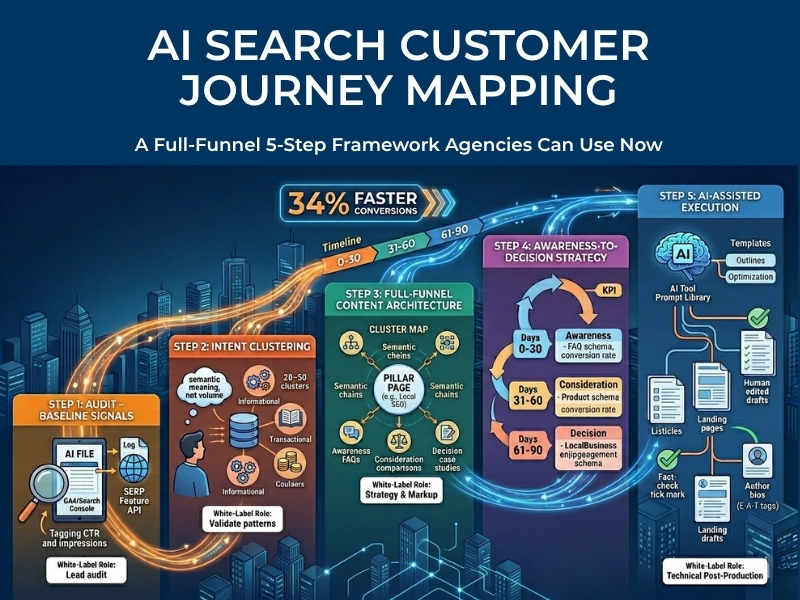
- The 5-Step AI Search Journey Framework
- Step 1: Audit – Baseline Signals
- Step 2: Intent Clustering
- Step 3: Full-Funnel Content Architecture
- Step 4: Awareness-to-Decision Strategy
- Step 5: AI-Assisted Execution
- Technical Requirements
- Measurement and Iteration
- Agency Checklist
- Frequently Asked Questions
AI search tools like Google’s AI Overviews and ChatGPT have rewritten the rules of how buyers discover and engage with businesses. Traditional keyword-based SEO assumes a linear progression, awareness, consideration, decision but generative AI skips entire steps, blending answers from multiple sources into a single response.
For agencies, this means outdated mapping methods no longer work. This guide offers a tactical framework to adapt, covering:
- AI search customer journey mapping – How users navigate fragmented, non-linear paths
- Intent clustering for generative search – Grouping queries by semantic meaning and funnel stage
- Full-funnel content optimization – Structuring content so AI surfaces it at the right moment
Designed for agencies with 3–10 employees and $500K–$5M in revenue, every step is executable in-house or through white-label partners like DakotaQ.
The Shift in Numbers
- 34% faster conversions when AI signals guide journey optimization
- 60–70% drop-offs at consideration due to misaligned intent signals
- 70–80% of conversions driven by 4–6 dominant journey patterns uncovered via intent clustering
These aren’t hypothetical gains—they reflect revenue missed by agencies still relying on linear funnels.
Why Map the AI Search Journey?
Traditional keyword targeting treats searches as isolated queries. AI merges them. A query like “best local SEO services” might pull from a FAQ, case study, and pricing page simultaneously, collapsing multiple funnel stages.
Generative tools also interpret intent differently. They analyze query clusters, not individual terms. If your content isn’t structured to appear across these clusters, it’s invisible.
AI search mapping addresses two critical gaps:
- Non-linear paths – Users jump from awareness to decision in one interaction
- Intent clusters – AI answers bundle related queries (e.g., “how does local SEO work?” + “cost of local SEO services”)
The 5-Step AI Search Journey Framework
An end-to-end process, adaptable for in-house teams or white-label execution:
- Audit – Baseline AI-influenced signals (queries, CTR, SERP features)
- Intent Clustering – Group queries by semantic meaning and funnel stage
- Content Architecture – Pillar-cluster structure for AI discovery
- Content Optimization – 90-day roadmap for full-funnel alignment
- Measurement – Track assisted conversions, time-to-decision, and SERP feature growth
Roles and Timelines
| Step | Deliverable | Agency Role | White-Label Role | Timeline |
|---|---|---|---|---|
| 1. Audit | Baseline report | Lead GA4/Search Console audit | – | 1-2 weeks |
| 2. Intent Clustering | Cluster CSV (20–50 groups) | Manual validation | API-generated embeddings | 1 week + 3–5 days |
| 3. Content Architecture | Pillar-cluster map | Strategy | JSON-LD markup | 2 weeks + 1 week |
| 4. Optimization | 90-day roadmap | Content briefs | Schema optimization | 4 weeks + 2 weeks |
| 5. Measurement | Dashboard | GA4 setup | Custom reporting | Ongoing |
Step 1: Audit – Baseline Signals
Start by analyzing how AI influences existing traffic and conversions.
Key Tools and Data
- GA4 – Behavior flow, conversion paths
- Search Console – Query impressions, CTR, SERP features (AI Overviews, snippets)
- Log files – Undercrawled or underperforming queries
- SERP APIs – Track generative feature dominance by cluster
Quick-Win Audit Actions
- Export top 1,000 queries from Search Console
- Note which trigger AI Overviews or featured snippets
- Use ChatGPT to analyze SERPs:
Prompt: “Analyze this SERP for generative features and intent signals: [paste SERP]” - Tag queries by funnel stage (awareness/consideration/decision)
- Flag CTR drop-offs, these indicate content or format gaps
Without this data, intent clustering is guesswork.
Step 2: Intent Clustering
Generative tools group related queries semantically. Your content should mirror this.
How to Build Clusters
- Generate embeddings – Use OpenAI API or sentence-transformers to convert queries to vectors
- Cluster programmatically – Apply UMAP (dimensionality reduction) + HDBSCAN (clustering)
- Label manually – Confirm intent (e.g., “what is local SEO?” = awareness; “hire local SEO agency” = decision)
Sample Output
| Query Examples | Intent | Funnel Stage | Content Type |
|---|---|---|---|
| “local SEO benefits” | Informational | Awareness | Explainer post |
| “local SEO vs. national” | Comparison | Consideration | Tool comparison |
| “local SEO agency pricing” | Transactional | Decision | Landing page |
Clusters become content briefs.
Step 3: Full-Funnel Content Architecture
AI doesn’t crawl linearly, it pulls from semantically linked content. Organize accordingly.
Content Types by Stage
- Awareness: FAQs, explainers (snippet-optimized)
- Consideration: Case studies, comparisons (HowTo schema)
- Decision: Pricing pages, testimonials (LocalBusiness schema)
Pillar-Cluster Structure
- Pillar page: Broad topic (“Local SEO Services”)
- Clusters: Subtopics (“Local SEO for Dentists”)
- Internal linking: Semantic anchors (“See pricing”, “Compare options”)
JSON-LD for AI Visibility
DakotaQ handles technical implementation (schema, taxonomies).
Step 4: Awareness-to-Decision Strategy
A 90-day rollout, phased by funnel stage:
Days 0–30: Awareness
- Publish: 5 FAQ posts (high-priority clusters)
- Technical: FAQ schema, Core Web Vitals check
- KPIs: Snippet CTR, AI Overview appearances
Days 31–60: Consideration
- Publish: Comparison pages + listicles
- Technical: Internal linking, Product schema
- KPIs: Engagement time, micro-conversions
Days 61–90: Decision
- Publish: Case studies, CTA-optimized landing pages
- Technical: LocalBusiness schema, conversion tracking
- KPIs: Conversion rate, time-to-decision
Step 5: AI-Assisted Execution
Use generative tools to streamline production, not replace human oversight.
Prompt Library
- Awareness outlines:
“Draft a 1,500-word post for [cluster]. Include FAQ schema-ready sections. Audience: [description].” - Meta optimization:
“Write a meta title/description for a [service] landing page. Include CTA.”
Quality Guardrails
- Fact-check all AI-generated content
- Add author bios for E-A-T
- Final editorial review before publishing
DakotaQ handles technical post-production (schema, internal linking).
Technical Requirements
AI won’t surface poorly structured content. Ensure:
- Performance: <2s load time (LCP <2.5s, CLS <0.1)
- Mobile-first: Responsive design
- Structured data: FAQ, HowTo, Product schemas
- Accessibility: Alt text, contrast ratios
DakotaQ provides white-label hosting (99.9% uptime) and technical builds.
Measurement and Iteration
Key Metrics
- Impressions by cluster (Search Console + SERP API)
- SERP feature rate (% queries triggering AI answers)
- Time-to-decision (GA4 conversion paths)
A/B Tests
- Content length: 800 vs. 1,500 words for snippets
- CTA placement: Above fold vs. mid-page
Agency Checklist
30 Days
Export queries, run clustering, publish 5 FAQ posts.
60 Days
Build comparison pages, set up GA4 tracking.
90 Days
Launch case studies, optimize CTAs, scale content.
The shift to AI search isn’t coming, it’s here. Agencies clinging to linear funnels will lose ground to competitors optimizing for generative discovery.
This framework is repeatable and scalable. Start with an audit, cluster intent, structure content for AI, and measure what matters. Pair it with white-label technical support for faster execution.
Ready to implement AI search mapping for your clients? Contact DakotaQ for a technical audit and white-label plan.
Frequently Asked Questions
How is intent clustering different from keyword research?
Keyword research groups terms by volume. Intent clustering groups by semantic meaning and behavior, revealing 4–6 dominant journey patterns driving most conversions.
Can small teams run this?
Yes. A strategist, writer, and technical partner like DakotaQ can execute for 1–2 clients/month.
Timeline for results?
Snippet impressions improve in 30–60 days; conversion lifts appear by day 90.
What’s the ROI on AI search journey mapping?
Agencies typically see 34% faster conversions and 25-40% improvement in qualified lead generation within 90 days of implementation.
Do I need to rebuild my entire content strategy?
No. The framework works with existing content through optimization and strategic gap-filling. Most agencies start with their top 20 performing pages and expand from there.