
Estimated reading time: 7 minutes
Key Takeaways
- EEAT guidelines in 2025 prioritize demonstrable real-world experience over theoretical knowledge.
- Brand authority is now Google’s primary trust signal, requiring structured evidence of credibility.
- Strategic AI implementation can amplify trust signals without compromising authenticity.
- Reputation monitoring using AI tools provides crucial early warning systems for brand protection.
- The most effective approach combines AI efficiency with rigorous human oversight and expertise validation.
Table of contents
The digital landscape of 2025 has fundamentally shifted how search engines evaluate content credibility. Google’s EEAT framework now serves as the ultimate gatekeeper for organic visibility, demanding more than just well-crafted content, it requires verifiable trust and demonstrable expertise.
For brands navigating this evolved terrain, the challenge isn’t just creating quality content; it’s proving authenticity in an era where AI-generated material floods search results. The solution lies in strategic AI implementation that enhances rather than replaces human credibility.
The Evolution of EEAT in 2025
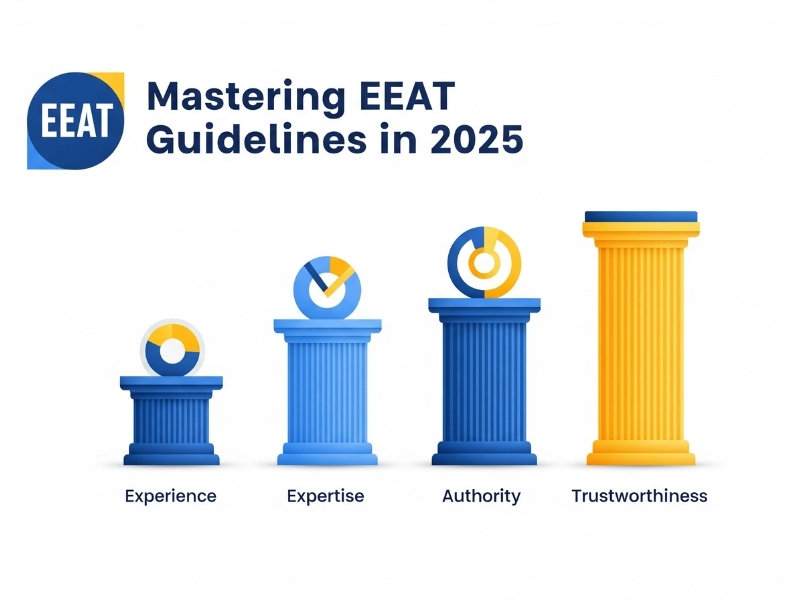
Google’s EEAT framework, Experience, Expertise, Authority, Trustworthiness has tightened its grip on content evaluation. Where past iterations rewarded well-researched material, the 2025 guidelines prioritize demonstrable real-world engagement.
For example, staying informed on emerging tech trends can further enhance your strategy. Consider exploring upcoming innovations discussed in Web Development Innovations to Expect in 2025 to better prepare for the future.
Core Shifts Worth Noting
- Experience: Firsthand accounts now outweigh third-party analysis. A product review from someone who’s used it for months outperforms aggregated specs.
- Expertise: Industry credentials matter, but so does depth. A cybersecurity firm’s guide to encryption carries more weight if authored by engineers with verifiable project history.
- Authorship Transparency: Anonymous content struggles. Bylines now demand LinkedIn profiles, publication histories, or other proof of legitimacy.
- Dynamic Trust Signals: HTTPS and privacy policies are baseline expectations. Google now scans for consistent accuracy, correction policies, and conflict disclosures.
For brands, this means SEO isn’t just about keywords, it’s about proving credibility through structured evidence.
Brand Authority: The Cornerstone of Search Success
Brand authority isn’t a vanity metric; it’s Google’s shorthand for reliability. Sites lacking it face algorithmic skepticism, while trusted sources enjoy ranking resilience—even amidst algorithm updates.
In addition to solid content, enhancing client engagement is key. Leveraging user-focused approaches, as outlined in Enhance Engagement with User-Focused Website Design, further solidifies your brand’s authority.
Tactical Authority Builders
- Case Studies Over Listicles: Instead of “10 Tips for Better Sleep,” publish “How Our Sleep Clinic Improved Patient Rest Efficiency by 37%.”
- Backlink Quality Control: A single link from Mayo Clinic trumps dozens of directory listings. Prioritize placements where contextual relevance aligns with your niche.
- Signature Content Formats: Develop research-backed frameworks (e.g., “The 2025 Local SEO Maturity Model”) that competitors cite organically.
- Executive Visibility: Encourage leadership contributions to platforms like Medium or industry journals. Google’s authorship algorithms track individual credibility across domains.
“A niche-specific authority strategy outperforms generic attempts every time.”
AI as a Trust Signal Amplifier
AI’s role isn’t to replace human expertise, it’s to scale its impact. When wielded strategically, it enhances trust signals without diluting authenticity.
Precision Applications
- Content Validation: AI fact-checks claims against PubMed, Statista, or SEC filings pre-publication, reducing errors that erode trust.
- Hyper-Personalization: Tools like Dynamic Yield customize site experiences based on user behavior, demonstrating attentiveness, a subtle trust marker.
- Sentiment Balancing: Algorithms detect tonal missteps (e.g., overly promotional language) before publishing, aligning with EEAT’s emphasis on neutrality.
Crucially, AI outputs must undergo human vetting. An LLM can draft a technical whitepaper, but a credentialed engineer should audit its assertions.
Reputation Monitoring: AI’s Surveillance Advantage
Real-time reputation tracking is no longer optional. Brands that ignore feedback loops risk algorithmic penalties when negative sentiment festers unchecked.
In addition, ensuring your website is accessible to all users can further strengthen your credibility. Learn more about inclusive approaches in Create Accessible Websites to Expand Your Client Reach.
Essential Monitoring Features
- Cross-Platform Aggregation: Consolidate mentions from Reddit, Trustpilot, and niche forums into a single dashboard.
- Emerging Crisis Detection: AI identifies PR risks early, like a product complaint gaining traction on TikTok before going viral.
- Competitor Benchmarking: Tools like Brandwatch compare your trust metrics against industry averages, spotlighting relative weaknesses.
Pro tip: Configure alerts for phrases like “scam” or “not trustworthy” paired with your brand name. Swift responses mitigate long-term SEO damage.
Implementation: Marrying AI Efficiency with Human Expertise
Phase 1: Audit & Align
- Inventory existing content. Flag pieces lacking author bios, citations, or experience disclosures.
- Use Clearscope or MarketMuse to identify EEAT gaps competitors address better.
Phase 2: Augment with AI
- Deploy Grammarly for tone consistency, Frase for EEAT-optimized outlines.
- Train ChatGPT on your style guide to draft human-editable content skeletons.
Phase 3: Human Oversight Protocols
- Assign subject-matter experts to review AI outputs before publishing.
- Mandate two-step verification for factual claims (AI suggestion + human verification).
Phase 4: Iterate with Data
- Track rankings for EEAT-heavy pages versus generic counterparts.
- Adjust AI training data based on which content earns featured snippets or backlinks.
Additionally, integrating strategies to lower bounce rates can complement your EEAT initiatives. For insights on retaining visitors, refer to Lower Website Bounce Rates with Engaging Strategies.
Furthermore, ensuring your website performs well on all devices is crucial. Enhance your mobile user experience by exploring Mobile Optimization Crucial for Website Success.
Frequently Asked Questions
Can AI-generated content rank well under EEAT?
Only when heavily refined by humans. Google’s “AI content” label rollout means purely synthetic text risks visibility dips unless paired with clear authorship and experiential depth.
How do small businesses compete with enterprise EEAT efforts?
Focus on micro-authority. A local bakery won’t outspend Walmart on backlinks but can dominate “artisan sourdough in [City]” via:
– Staff-authored baking tutorials
– Locally embedded schema markup
– Responding to every Google Review
Which AI tools offer the best EEAT ROI?
Start with:
– Originality.ai (detects synthetic text risks)
– Mention (budget-friendly reputation monitoring)
– SurferSEO (optimizes for EEAT-friendly structure)
EEAT compliance in 2025 demands a hybrid approach, leveraging AI’s speed while anchoring output in human credibility. Brands that systematize this balance will thrive as search algorithms increasingly reward authenticity.
The tools exist; the strategy is clear. Those who act now won’t just adapt to EEAT, they’ll define its standards for others.