
Estimated reading time: 12 minutes
Key Takeaways
- Snippet-ready formatting increases AI summary visibility without additional ad spend
- AI prioritizes structured content with clear headings, direct answers, and scannable lists
- Use H2 questions, 40-60 word answers, and bullet points for optimal extraction
- Schema markup and semantic HTML significantly boost content discoverability
- Agencies can implement scalable workflows using content blocks and micro-templates
Table of contents
- Why AI Prioritizes Structured Content
- Snippet-Ready Formatting Defined
- Key Signals AI Uses to Select Content
- Heading Hierarchy for Optimal AI Extraction
- Designing AI-Friendly Content Blocks
- Chunking Content for LLM Processing
- Blog Post Formatting for AI Search
- Before and After: Snippet-Optimized Examples
- Technical Boosters: Schema, HTML, and Links
- Agency Workflow for Scalable Implementation
- Tracking Performance and Iterating
- Top Mistakes and How to Fix Them
- Quick-Reference Snippet Checklist
- Final Takeaways
- Frequently Asked Questions
Snippet-ready content formatting increases the likelihood of articles appearing in AI summaries, featured snippets, and knowledge panels. For agencies, this means more visibility without additional ad spend.
AI systems prioritize content that’s easy to extract, think clear headings, direct answers, and scannable lists. Unstructured walls of text get overlooked.
This guide is for:
- Agencies building repeatable content workflows
- Teams publishing blogs or service pages
- White-label partners requiring clean technical handoffs
By the end, you’ll know how to structure content so AI tools like Google SGE can easily pull and display it. SEO in ChatGPT responses follows similar principles.
Why AI Prioritizes Structured Content
AI doesn’t “read” content like humans. It scans for signals:
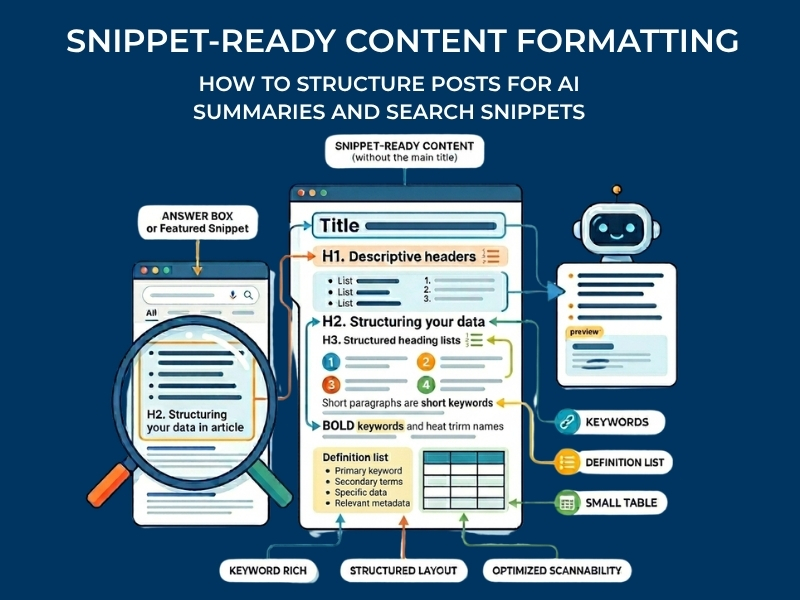
- Heading hierarchies (H1 > H2 > H3)
- Concise answers (40–60 words) beneath headings
- Bullet/numbered lists with 3–7 items
- Q&A formats with schema markup
This applies to blogs, service pages, or documentation, any content type can be optimized.
The shift for agencies:
Quality and structure now directly impact visibility. Keyword stuffing won’t cut it; clean formatting does.
Snippet-Ready Formatting Defined
Snippet-ready formatting means structuring content for easy AI extraction: concise answers, question-based headings, and schema markup.
Key Goals:
- Featured snippets: 40–60 word paragraphs under H2s
- List extractions: 5–7 bullet points per section
- Higher CTRs from AI overviews
- Organic traffic lifts without paid ads
Rewriting existing content with this structure has driven 180% traffic increases in some cases.
Before vs. After:
Non-optimized:
“Content optimization involves keywords, backlinks, and UX. Agencies struggle with visibility due to frequent algorithm changes.”
Snippet-ready:
Snippet-ready formatting uses H2 questions, 1–2 sentence answers, and bullet lists. This signals AI to extract precise summaries, boosting visibility without paid ads.
The second version wins with clear structure and directness.
Key Signals AI Uses to Select Content
AI looks for specific cues to determine extractability:
Primary Signals:
- Heading hierarchy: H1 (topic), H2s (questions), H3s (details)
- First-sentence summaries: Direct answers under H2s
- Lists/tables: Bullet points or structured comparisons
- FAQ schema: Explicitly labeled Q&A pairs
- Metadata: Title tags and meta descriptions as answers
Best Practices:
- Inverted pyramid: Answer first, details after
- Short paragraphs: 3–5 sentences max
- Semantic HTML:
<h1>–<h3>,<ul>,<table>tags
Focus on extractability, not keyword density.
Heading Hierarchy for Optimal AI Extraction
Rules for Headings:
- One H1 per page (primary topic)
- H2s as user questions (5–10 words)
- H3s for supporting details
Weak vs. Strong Headings:
| Weak | Strong |
|---|---|
| Content Tips | How to Format Headings for AI Snippets? |
| SEO Basics | What Signals Does AI Use for Snippets? |
Template for Headings:
H1: [Primary Keyword + Topic]

H2: [User Question]

H3: Short Answer

H3: Supporting Bullets (3–5)
Designing AI-Friendly Content Blocks
A content block is a self-contained unit AI can extract independently.
Structure of a Content Block:
- Heading (H2/H3): Clear, query-based
- Direct answer: 40–60 words
- Bullets: 3–5 action-driven points
- Example/case study (optional)
Example: Service Page Block
How Does White-Label Development Help Agencies?
White-label partners handle schema markup, anchor links, and semantic HTML so agencies focus on content.
- JSON-LD FAQ schema per page
- Anchor links on all headings
- 48-hour implementation turnaround
Match block types to query intent:
- What is…? → Paragraph answer
- How to…? → Numbered steps
- Best X for Y…? → Bullet list
Chunking Content for LLM Processing
Chunking breaks long-form content into standalone 150–300 word sections, each with a clear heading, anchor ID, and self-contained context.
Why It Works:
- Helps AI retrieve specific sections
- Reduces irrelevant extraction
- Improves citation accuracy
Implementation Tips:
- Add
idattributes to headings - Use
<details>/<summary>for expandable mobile sections - Link to chunks from tables of contents
Blog Post Formatting for AI Search
Checklist for AI-Optimized Posts:
| Element | Action |
|---|---|
| Intro | Start with a 40-word direct answer |
| H2s | Phrase as user questions |
| Lists | 5–7 bullets/numbers per section |
| Schema | Add JSON-LD FAQ markup |
| Images | Include query in alt text |
| Tables | Use for comparisons |
Intro example:
Weak: “We’ll explore strategies for modern search visibility.”
Strong: “AI-ready formatting uses H2 questions, short answers, and schema. This boosts visibility without ads.”
Before and After: Snippet-Optimized Examples
Example 1: Blog Post
Before:
“SEO requires understanding snippet types, which evolve as algorithms update.”
After:
What Are the Types of Featured Snippets?
Featured snippets appear in three formats:
- Paragraphs: 40–60 words under H2s (60% of snippets)
- Lists: 5–7 bullet points (25%)
- Tables: Comparison data with headers
Example 2: Service Page
Before:
“We offer web development, design, and SEO services.”
After:
What Web Development Services Do You Provide?
We deliver white-label WordPress builds, technical SEO, and schema markup. Most projects complete in 48–72 hours.
- Custom WordPress development
- JSON-LD schema implementation
- On-page SEO audits
Technical Boosters: Schema, HTML, and Links
JSON-LD FAQ Schema Example:
<script type="application/ld+json">

{

"@context": "https://schema.org",

"@type": "FAQPage",

"mainEntity": [{

"@type": "Question",

"name": "What is snippet-ready formatting?",

"acceptedAnswer": {

"@type": "Answer",

"text": "Structuring content with question-based headings, 40–60 word answers, and schema for easy AI extraction."

}

}]

}

</script>
HTML Best Practices:
- Use
<h1>–<h3>,<ul>,<table>tags properly - Add
idattributes to headings for deep linking - Avoid visual styling without semantic markup
Developer Handoff Template:
Task: Snippet Implementation

Actions:

1. Add FAQ schema

2. Apply heading IDs

3. Verify semantic HTML

4. Set canonical tags
Agency Workflow for Scalable Implementation
5-Step Snippet Workflow:
- Research target queries using People Also Ask and competitor snippets
- Draft one-line answers before writing full sections
- Build content blocks (H2 + answer + bullets)
- Add schema markup post-content
- QA structure with tools like Hemingway
Micro-Templates:
- TL;DR Block: “One-sentence answer to the query.”
- FAQ Pair:
H3: [Question]

<p>[40–60 word answer]</p> - Bolded Summary: Restate key points in bold at section ends
Tracking Performance and Iterating
Key Metrics:
- Snippet appearances (Google Search Console)
- AI overview placements (manual checks)
- Organic impressions/CTR
Test and refine:
- Compare structured vs. unstructured page versions
- Update headings/answers based on performance drops
- Expand schema to high-traffic pages
Top Mistakes and How to Fix Them
Mistake 1: Walls of Text
Fix: Break into 150–300 word chunks with headings.
Mistake 2: Generic Headings
Fix: Rewrite H2s as questions (e.g., “How Do Headings Help AI?”).
Mistake 3: Missing Schema
Fix: Implement FAQ or Article schema via JSON-LD.
Mistake 4: Skipping Heading Levels
Fix: Maintain H1 > H2 > H3 hierarchy strictly.
Quick-Reference Snippet Checklist
| Task | Detail |
|---|---|
| H1/H2 query alignment | One H1; H2s as questions |
| Answer length | 40–60 words under headings |
| Lists | 3–7 bullets/numbers |
| Schema | FAQPage markup applied |
| Chunk size | 150–300 words per section |
| HTML tags | <h1>–<h3>, <ul>, <table> used |
Final Takeaways
Snippet-ready formatting will only grow in importance as AI answers expand. Agencies that adopt structured workflows now will outperform competitors relying on outdated tactics.
Start small:
- Apply formatting to high-traffic pages first
- Use templates for new content
- Track metrics and iterate
The winning strategy? Extractability over keyword density.
Frequently Asked Questions
How long should snippet answers be?
40–60 words long enough to be complete, short enough to avoid truncation in AI summaries and featured snippets.
Does schema markup help with AI extraction?
Yes. FAQ and Article schema explicitly signal content structure to AI systems, making your content more discoverable and extractable.
What’s content chunking for AI?
Breaking content into standalone sections (150–300 words) with headings and IDs for easier AI processing and more accurate citations.
How often should snippet-optimized content be updated?
Review every 60–90 days using performance data. Refresh underperforming headings or answers based on search console metrics.