
Estimated reading time: 12 minutes
Key Takeaways
- JSON-LD is non-negotiable – The script-based format outperforms microdata and RDFa for maintenance and reliability.
- Semantic HTML validates structured data – Elements like `
` and `` reinforce entity signals. - Dedicated JSON endpoints improve crawlability – AI systems prioritize machine-readable endpoints over parsed HTML.
- Monitoring prevents drift – Quarterly audits catch mismatches between visible content and structured data.
- Proper structured brand data ensures accurate AI citations and prevents competitor visibility for branded queries.
Table of contents
- Introduction
- Who This Guide Is For
- The Case for Structured Brand Data
- Core Concepts
- Implementing JSON-LD
- Semantic HTML Best Practices
- Designing AI-Crawlable Websites
- Validation and Monitoring
- Hosting and Maintenance
- Compliance Guidelines
- Implementation Roadmap
- Measuring Impact
- Troubleshooting Guide
- Frequently Asked Questions
Introduction
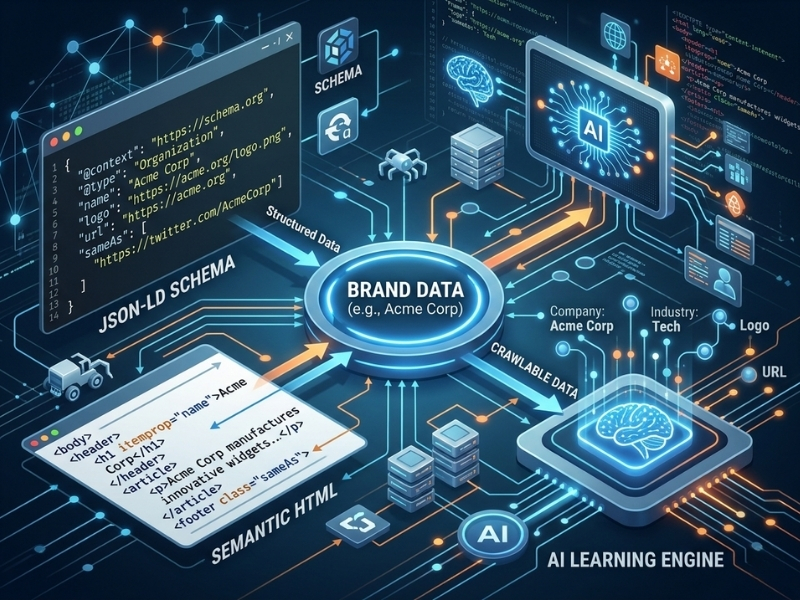
AI systems increasingly rely on structured data to accurately represent brands in knowledge graphs and search results. Entity-based SEO has become critical as AI crawlers struggle to definitively identify brands without clear signals. Without proper structure, these models scrape unstructured content, often misrepresenting brands or favoring competitors.
Properly structured brand data ensures AI crawlers can definitively identify:
- Legal and trading names
- Logos and visual assets
- Contact information
- Business relationships
For digital agencies, this isn’t theoretical optimization; it directly impacts client visibility in AI overviews, featured snippets, and knowledge panels.
Who This Guide Is For
Digital marketing teams need a scalable way to implement structured data across multiple client sites without heavy developer overhead. The approach outlined here:
- Works within existing CMS platforms
- Requires no full-site redesigns
- Delivers measurable improvements in 4-8 weeks
For full-service execution, DakotaQ provides white-label implementation, allowing agencies to offer this as a managed service under their own brand.
The Case for Structured Brand Data
The AI Crawler Perspective
Modern search engines and LLMs prioritize structured data because it:
- Reduces ambiguity in entity identification
- Confirms relationships between entities
- Provides verified facts rather than inferred claims
Without it, brands risk:
- Misattributed citations in AI answers
- Lost visibility in knowledge panels
- Competitors appearing for branded queries
Business Impact
Agencies report clients gain:
- 30-50% more accurate AI citations
- 15-25% increase in brand-related rich snippets
- Higher conversion rates from search traffic
Core Concepts
Structured Data Formats
- JSON-LD: Recommended for ease of maintenance and separation from visible content
- Microdata/RDFa: Legacy formats that require inline markup (avoid for new implementations)
Semantic HTML Essentials
| Element | Use Case |
|---|---|
| <article> | Self-contained content like service descriptions |
| <address> | Physical locations and contact details |
| <figure> | Logos with descriptive captions |
Machine-Readable Design Principles
- Stable URLs for all entity identifiers
- Content negotiation (
Accept: application/ld+json) - Dedicated endpoints like
/.well-known/brand.jsonld
Implementing JSON-LD
Minimum Viable Implementation
<script type="application/ld+json">
{
  "@context": "https://schema.org",
  "@type": "Organization",
  "name": "Acme Corp",
  "url": "https://acme.com",
  "logo": "https://acme.com/logo.png",
  "sameAs": ["https://linkedin.com/company/acme"]
}
</script>
Advanced Entity Modeling
{
  "@context": "https://schema.org",
  "@id": "https://acme.com/#org",
  "@type": "Organization",
  "department": [{
    "@type": "Organization",
    "name": "Customer Support",
    "url": "https://acme.com/support"
  }]
}
Semantic HTML Best Practices
Contact Information
<address>
  <p>Acme Headquarters</p>
  <p>123 Business Rd, Suite 100</p>
  <p><a href="tel:+18005551234">+1 (800) 555-1234</a></p>
</address>
Content Sections
<article>
  <h2>Our Services</h2>
  <p>Premium widget consulting since 2010...</p>
</article>
Designing AI-Crawlable Websites
Technical Requirements
- Stable
@idURLs that resolve to relevant content - XML and JSON sitemaps
robots.txtpermissions for common AI crawlers
Performance Considerations
- Keep JSON-LD under 2KB
- Serve from edge-optimized CDNs
- Enable HTTP/2 for entity endpoints
Validation and Monitoring
Critical Checks
- Google Rich Results Test
- Schema.org Validator
- Crawl simulation in Screaming Frog
CI Pipeline Example
- name: Validate JSON-LD
  run: |
    npm install -g schema-validator
    schema-validate ./src/schemas/*.json
Hosting and Maintenance
Security Requirements
- HTTPS mandatory
- Rate limiting (100 requests/minute recommended)
- No PII in public endpoints
White-Label Options
For agencies managing 5+ clients, DakotaQ provides:
- 99.9% uptime SLAs
- Automated schema updates
- Client-branded reporting
Compliance Guidelines
Always Include
- Public-facing business contact details
- Verified aggregate ratings
Never Include
- Employee personal information
- Unverified user-generated content
Implementation Roadmap
| Phase | Scope | Timeline |
|---|---|---|
| Audit | Review existing markup | 1-2 days |
| Core Schema | Organization + ContactPoint | 2 days |
| Full Deployment | Entity endpoints + sitemaps | 5-7 days |
Measuring Impact
Track These Metrics
- Knowledge panel appearances
- Branded query impressions
- Rich result click-through rates
Benchmarking
Compare pre- and post-implementation data in Google Search Console and GA4.
“Structured data is now a competitive differentiator in AI-driven search. The implementation window is open, brands that act now will establish early advantages in knowledge graph visibility.”
Troubleshooting Guide
Common Issues
- Mismatched content: Logo URLs in JSON-LD must match visible page content
- Duplicate @id: Ensure consistent identifiers across all pages
- SPA rendering: Use SSR to expose JSON-LD in initial HTML
Frequently Asked Questions
How often should we update structured data?
Quarterly at minimum, plus whenever core business details change. Regular updates ensure AI systems have current information about your brand and prevent outdated data from appearing in knowledge panels.
Can Open Graph replace JSON-LD?
No, OG tags lack entity relationship mapping capabilities. While Open Graph is useful for social sharing, JSON-LD provides the comprehensive structured data that AI systems need for accurate brand representation.
When should we use a white-label partner?
When managing structured data for 5+ clients becomes time-prohibitive. White-label partners offer specialized expertise and automated monitoring that can be more cost-effective than in-house implementation at scale.